
AI Bubble Burst Myths and Facts: What Marketers Should Know
The AI bubble burst debate affects your budget, your vendors and your plans for next year. You do not need to predict a crash to prepare for one. You need to know which claims are myths and which are facts.
Here is the short version. Prices look stretched. Adoption is real. Both statements are true at the same time.
What "bubble" actually means
A bubble is a price problem. Prices rise faster than the earnings that justify them, and when expectations reset, prices fall. The technology can stay useful throughout. After the dot-com crash, Pets.com disappeared, and Amazon went on to dominate. The warnings are now official. In October 2026, the IMF ranked a correction in AI prices among the three main risks to global financial stability.
A warning is not a forecast, so let us test the common claims one by one.
Myth 1: A dot-com style crash is certain
Fact: Valuations are stretched, but timing and size are unknown.
The Bank of England says US valuations are close to the most stretched since the dot-com bubble. The IMF's chief economist also sees similarities with the late 1990s. Still, the Bank's own measures do not uniformly show a market more extreme than the dot-com peak, and it described a vulnerability, not a forecast.
Myth 2: Nobody really uses AI
Fact: People use it widely. Businesses use it unevenly.
Stanford's 2026 AI Index says generative AI reached about 53% population adoption within three years, faster than the PC or the internet. Business data is more modest. US Census data show AI use among firms stayed between 17% and 20% from December 2025 to May 2026, with the Information sector at 39.7%. Survey wording changes these numbers, so always compare like with like.
Myth 3: Strong AI revenue proves there is no bubble
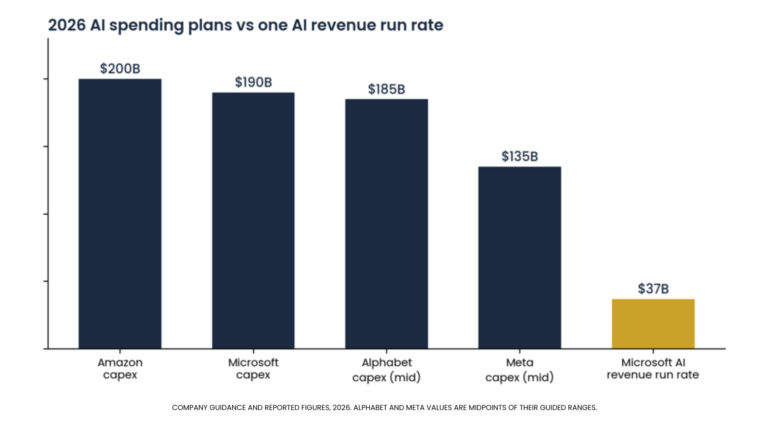
Fact: Revenue is growing fast, but spending is growing faster.
The four largest US hyperscalers are on track to spend about $700 billion on capital expenditure in 2026. Microsoft's AI business passed a $37 billion annual run rate. Demand is real. Google Cloud grew 63%, and AWS grew 28% in Q1 2026. The open question is whether revenue catches up with the bill.
Myth 4: "95% of AI projects fail," so it must be a bubble
Fact: Pilots do stall, but this study is thin evidence.
MIT's NANDA report found that 95% of pilots showed no measurable profit impact. The report called itself preliminary and drew methodology criticism, including a Wharton professor who called it a clear case of confirmation bias. The report itself blamed weak workflow integration, not model quality. It also found that over half of budgets went to sales and marketing, while the best returns came from back-office automation.
Myth 5: Big Tech pays in cash, so debt is not a risk
Fact: Debt financing is rising fast.
The Bank of England's committee cited a JPMorgan estimate of about $4.1 trillion in debt-financed AI capex from 2026 to 2030. It also cited a Morgan Stanley estimate that about $700 billion of data centre spend will come through private credit from 2026 to 2028. Cash flow is tight too. Morgan Stanley estimates Amazon will post negative free cash flow of nearly $17 billion in 2026.
Myth 6: If the AI bubble bursts, it disappears
Fact: A burst hits prices and funding, not the technology.
The IMF's downside scenario, an AI investment pullback plus a valuation correction, trims about 0.4% from global GDP by 2028. That is a dent, not a collapse. Bank of England Governor Andrew Bailey still told G20 finance ministers in August 2026 that a disorderly correction would be a disaster. Both views matter. Internet use kept growing after 2000, and the fibre laid during that boom was used later.
Myth 7: Central banks have predicted an AI crash
Fact: They are flagging conditional risk.
Coverage of the IMF warning stresses that it does not mean a burst is certain. The Bank of England said the risk of a sharp correction had increased and that valuations look stretched. Meanwhile, the AI boom is lifting growth today. In January 2026, the IMF raised its global forecast to 3.3%, saying AI investment offset the tariff drag.
Myth 8: AI demand is unlimited, so power and chips will never be a constraint
Fact: Demand is huge, but physical limits are real.
The IEA projects data centre electricity demand will more than double to about 945 TWh by 2030, slightly more than Japan uses today. Data centre demand rose 17% in 2025, against 3% for global demand overall. The IEA also warns that grid bottlenecks could delay about 20% of planned projects. In the UK, 140 proposed data centre schemes could need 50 GW, which is 5 GW above current peak demand.
Myth 9: AI hardware lasts like railways or fibre
Fact: Much of it ages quickly.
Analysis of hyperscaler spending points to the short useful life of many AI assets. About 75% of hyperscaler capex, roughly $450 billion, goes to AI infrastructure. Faster write-downs raise the payback pressure. Analysts flag Meta as most exposed to a depreciation overhang if revenue does not accelerate.
Myth 10: AI bubble burst only hurts tech investors
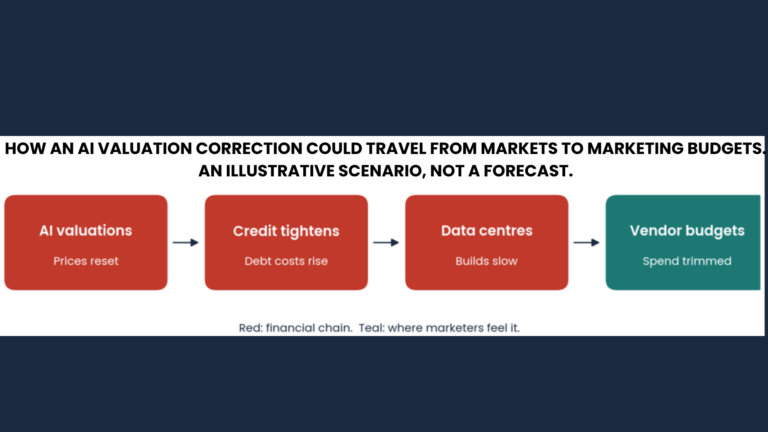
Fact: It spreads through index funds and credit.
Microsoft, Alphabet, Amazon and Meta together make up about 44% of the S&P 500's market capitalisation, so anyone with an index fund holds them. The Bank of England says deeper links between AI firms and credit markets could spill over to the wider economy. Its committee also said a reassessment of AI earnings could affect sovereign debt markets.
What this means for marketers
You do not control valuations. You do control how exposed your plan is.
• Tie every AI tool to an outcome. If a tool cannot show a measurable result, it is a cost, not an investment.
• Check vendor health. Ask how a vendor funds itself. Tools backed by heavy debt carry more pricing and continuity risk.
• Build proof into your content. Buyers are more sceptical, so case data and named sources win over big claims.
• Keep a human layer. MIT's finding that returns come from integration and workflow applies to content teams too.
Conclusion: ask better questions before the market answers for you
Nobody can time a correction. The data supports a balanced view. Adoption is real, valuations are stretched, and debt and power limits add risk. Your job is to stay useful in either outcome.
Ask yourself four things this quarter:
- Which of my AI tools tie to revenue, leads, or cost savings I can measure?
- If a key vendor raised prices or shut down, what would break first?
- Does my content answer the questions buyers ask when they doubt AI claims?
- Is my positioning built on proof, or on the same promises everyone else makes?
If any answer feels uncertain, you have a clear place to start, and starting early is an advantage.
This is where Writopia Analytics can help. We engage with business content and analytics. We build SEO & content strategy around the questions your buyers actually search. We add B2B content market intelligence so you see what competitors say and where the gaps are. The result is clear positioning, backed by evidence. Also, the market will keep moving with a sharp, well-evidenced position holding up in both directions.